

Exhibitions that look back over an individual’s career often have to address a basic question, why is it worth revisiting their work now? Sometimes the answer is as simple as this artist or designer has not received the attention their work deserves, especially if, it turns out, they have long explored topics that others are only just beginning to consider. Other times, they either encapsulate a moment in time that is relevant to the present day or they can change, alter, deepen, reconfigure our understanding of a certain history. In other cases, their work is seen as a salve for present struggles and argued for on the grounds of urgency.
This latter reason has been evoked for Peter Kennard’s Archive of Dissent at Whitechapel Gallery. Sarah Kent, reviewing the exhibition for the Arts Desk, described Kennard’s skills in creating political photomontage as “needed more than ever”. Writing in the Observer, Laura Cumming said that Kennard’s work is “ever-necessary” adding that if the new Labour government starts to flag, its MPs should take a trip to the show to see that “things don’t always get better”. But I came away from the show wondering whether Kennard’s potent images truly help articulate present issues.
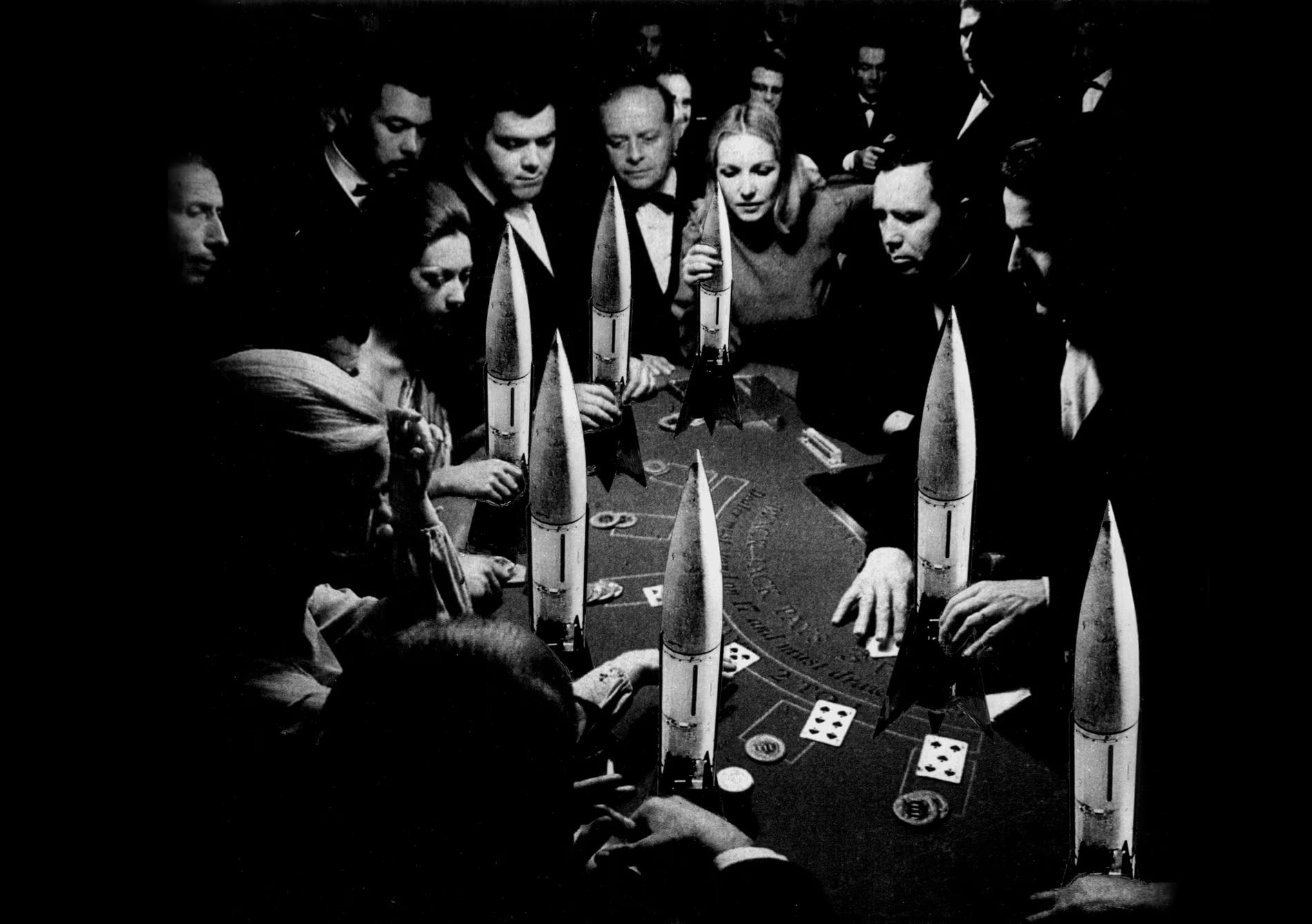
Radicalised by 1968 and the Vietnam War, Kennard, 75, began making photomontages in the 1970s for leftwing causes, including Campaign for Nuclear Disarmament, Stop the War, and the Anti-Apartheid Movement. As a result, Archive of Dissent, displayed in what used to be Whitechapel’s library, feels like a catalogue of many of the major political struggles of the last 50 years. A hanging rack displays Kennard’s poster designs on sheets of cardboard, as if they were once placards for a march. Here, a skeleton reads the government’s Protect and Survive leaflet from 1980 explaining how to survive a nuclear attack and a mushroom cloud forms the head of another skeleton. There is John Constable’s Hay Wain with added cruise missiles and Kennard’s The Gamble (1986), which shows a black jack table covered in rockets and surrounded by figures, is repurposed with the caption “Welcome to the G8”.
Many of Kennard’s photomontages take enemies and issues that figured large in the late 20th century, manipulating them “to create critical collaged images” that reveal “hidden meanings or true (often destructive) nature.” Nuclear warheads and Margaret Thatcher are recurring themes, as well as space travel and images of the earth, speaking to the cold war, the beginnings of neoliberalism, the space race and global conflict.
It makes sense to see these 20th century figures and themes criticised and exposed through Kennard’s photomontage. Photomontage was first used by the Dadaists to protest against the First World War. Later John Heartfield used the technique to make anti-Nazi and anti-fascist art. Discovering Heartfield and Hannah Höch in the 1970s, Kennard realised he could make reproducible work that related immediately to what was happening in the world. Walter Benjamin was another major influence on Kennard. In the essay The Author as Producer, Benjamin argues that the author must address class struggle and help adapt production towards the aims of revolution, while highlighting photomontage as containing a revolutionary attitude and Heartfield “whose technique made book jackets into a political instrument.”
Photomontage and these other inspirations firmly situate Kennard’s work in a 20th century, modernist tradition. But this is where my uncertainty creeps in, especially around one work in particular, The People’s University of the East End (2024), which takes its name from the colloquial name for Whitechapel’s library. The work displays placard designs on cardboard sheets, like the hanging rack nearby. The placards include the same subjects and themes as Kennard’s other work and present older works which have been updated in some instances. There are also newer works, which look at the conflicts in Ukraine and Gaza. These works include a Palestinian flag sitting in the bottom half of a sand timer while a skull sits in the top half, and another where the red triangle of a Palestinian flag is dripping blood. There is also an image of Julian Assange behind a tattered flag of the United States and a globe which appears to be leaking oil. The images barely reveal any hidden meanings nor do they feel like a call to action. The placards are also cordoned off with police tape, as if we need telling that the images are more provocative, dangerous than they are.
As a historical show, and one that shows Kennard’s artistry at its finest, the photomontage work on display sings and can be deeply powerful. But Kennard’s desire to comment on contemporary conflicts only exposes how outmoded these techniques are. When we are bombarded with horrors everyday, there is little the idea of ticking time or trickling blood can do for our understanding of what is taking place in Gaza.
Kennard says: “My art erupts from outrage at the fact that the search for financial profit rules every nook and cranny of our society. Profit masks poverty, racism, war, climate catastrophe and on and on… My aim is to unmask that.” It’s when Kennard moves away from photomontage that I feel he gets closer to unmasking financial profit in the 21st century. Word Markets (1997–2024) shows distressed faces barely pressed on sheets on newspaper while Double Exposure (2023) sees Kennard’s images projected onto pages of the Financial Times, with different combinations of images lighting up as you watch. The lights, which you can hear clicking on and off and are operated by a Raspberry Pi computer, pull your eyes across the work, suggesting changing relationships between the different images and pages. The works may not share the scalpel-sharp power of Kennard’s other images, but they move towards a conspiratorial visual language which I think better encapsulates people’s attitude towards eerie, unplaceable powers that we know – or sense – shape our world.